

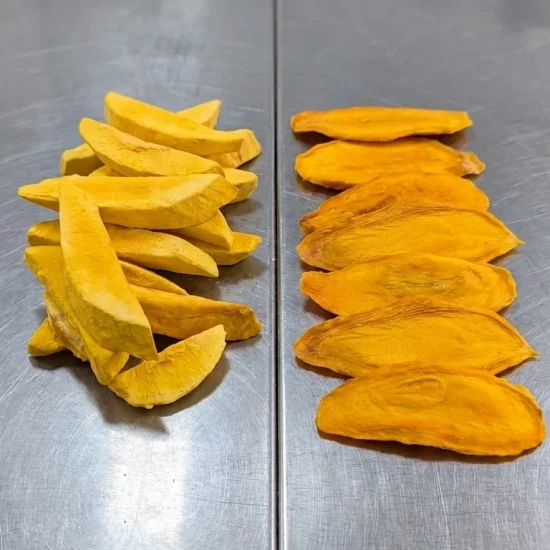
When you hear “dried fruit,” you picture one category, same product, different brand, slightly different quality. A dried apricot is a dried apricot. But this assumption breaks down the moment you look closer.
Freeze dried fruit and dehydrated fruit both start as fresh fruit. Both lose their moisture. Both end up shelf-stable, lightweight, and long-lasting. You’ll find them in the same aisle, sometimes with nearly identical names on the packaging.
But the similarities end there, and the gap between them is larger than most people expect.
The color is different. The texture is different. The flavor is different. The shelf life is different. The weight is different. And the price, sometimes shockingly different. A kilogram of bulk freeze dried strawberries can cost three to five times more than the same weight in dehydrated strawberries.
That’s not a premium for branding or marketing. It’s the direct result of two processes that have almost nothing in common — except the fruit they start with.
This guide explains what actually separates them, why the difference matters, and how to know which one belongs in your product, your kitchen, or your supply chain.
Two Processes, Two Completely Different Results
The reason these two products look, taste, and behave so differently comes down to one thing: how the moisture is removed.
Freeze-Drying: No Heat Involved
In freeze-drying, the fruit is first frozen rapidly, typically to temperatures between -40°C and -50°C. Then it goes into a vacuum chamber where pressure is reduced significantly. At that pressure, the frozen water inside the fruit converts directly from ice to vapor, bypassing the liquid stage entirely. This process is called sublimation.
The fruit loses its water content without ever being exposed to heat. Its cell structure stays largely intact. Its natural pigments survive. Its aromatic compounds, the ones responsible for how fruit smells and tastes, remain in place.
The result is a product that is light, crisp, and visually close to fresh fruit. Residual moisture typically sits at 1–3%.
For a full technical breakdown of how freeze drying works as a process, we covered it in detail separately, [what is freeze dried fruit] is the right starting point if you want to go deeper on the science.
Heat-Drying: The Conventional Method
Dehydration works differently. Warm air, typically between 50°C and 75°C depending on the fruit, is circulated over the product for an extended period until most of the moisture evaporates. It is a well-established, energy-efficient process that has been used in food production for decades.
But heat changes things. It triggers browning reactions that darken the fruit. It drives off the volatile aromatic compounds that contribute to fresh flavor. It degrades heat-sensitive vitamins. The fruit loses its moisture, but it also loses some of what made it look and taste the way it did when fresh.
The result is a denser, chewier product with a concentrated flavor. Residual moisture sits at 8–20%.
The Differences That Actually Matter for Sourcing
Color
This is where the gap between the two formats is most visible — literally.
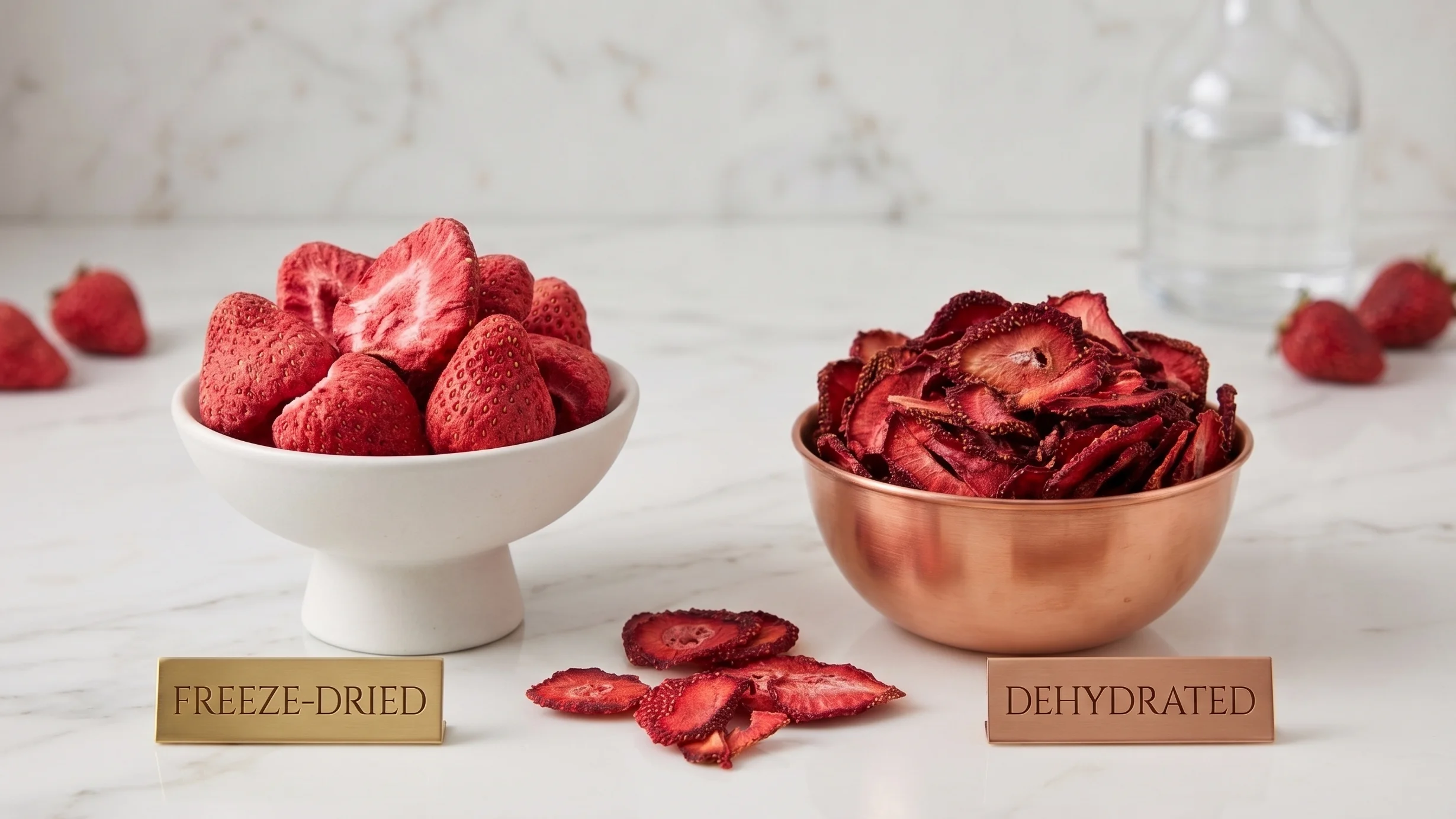
Freeze-dried fruit retains its natural pigmentation because no heat is applied. Freeze-dried strawberries stay bright red. Freeze-dried mango holds the original color of fresh mango. Freeze-dried kiwi looks slices looks exactly as the same as fresh kiwi slices. Open a bag and the pieces look close to fresh fruit.
Dehydrated fruit is darker. The browning that occurs during heat drying is a natural chemical reaction, not a sign of poor quality, but it changes the appearance noticeably. Dehydrated strawberries are a deep burgundy.
Texture
Freeze-dried fruit is light and crisp. It breaks cleanly and dissolves quickly when it contacts moisture. Pick up a piece and it almost feels like it shouldn’t weigh that little. Although Dehydrated fruit is dense and chewy. It has real bite to it.
Neither texture is inherently better. The question is what type you prefer; Crunch and lightness, or chew and density.
Flavor Profile
Both freeze dried and dehydrated fruit taste more concentrated than fresh. When the water is removed, the natural sugars intensify, so a freeze dried and a dehydrated apple slice are both noticeably sweeter than a fresh one, that’s true for both formats without exception.
The difference is in what happens to the aroma.
Both drying methods change the volatile compounds responsible for how fruit smells and tastes. But they change them differently. Heat triggers chemical reactions that break down the fresh, natural aroma compounds and replace them with new ones — the cooked, jammy notes that are characteristic of conventionally dried fruit. Freeze-drying, because no heat is involved, largely avoids these reactions. Some volatile compounds are still lost, but the ones that remain are closer to what the fresh fruit smelled like.
Shelf Life
Both drying methods extend shelf life through the same fundamental mechanism: reducing water activity (Aw). Water activity measures how much free water is available in a product for microbial growth and chemical reactions. A water activity below 0.60 prevents all microbial growth, and both freeze drying and heat drying bring products well below that threshold. That’s why both formats are shelf-stable at room temperature without refrigeration.
Dehydrated fruit loses roughly 80–94% of its water during drying, leaving residual moisture at around 6–20%. That’s low enough to suppress most microbial activity, but not all chemical reactions. Oxidation, enzyme activity, and gradual moisture reabsorption from the environment continue slowly over time. The practical result is a shelf life of approximately 12 to 18 months under proper packaging and storage conditions.
Freeze dried product, when properly packaged and stored, can last up to 10 years. With residual moisture at just 1–3%, water activity drops to a level where almost no biological or chemical degradation can occur. The product becomes genuinely stable over the long term, not just shelf-stable in the conventional sense.
Once opened, freeze-dried fruit should be consumed within 6 to 12 months, as exposure to ambient humidity causes rapid moisture reabsorption. The same product that lasts decades in a sealed bag can soften and lose quality within weeks if left open.
Packaging matters significantly for both formats. Moisture-barrier bags, oxygen absorbers, and airtight seals are what make long shelf life claims realistic, not the drying process alone.
Weight and Volume
Freeze drying removes up to 90% of the original water weight. Dehydration removes significantly less, typically 60–80%.
This means freeze dried fruit is much lighter than heat dried fruit. For instance a kilogram of freeze dried strawberries represents roughly twice the fresh fruit volume of a kilogram of dehydrated strawberries.
Cost Per Kilogram
Freeze-dried fruit costs more. The process requires more energy, more time, and more expensive equipment than heat-drying. That cost is real and does not disappear regardless of supplier or origin.
For applications where freeze-dried quality is necessary, the premium is justified. For applications where it is not, paying it is poor procurement.
Bulk dehydrated fruit is a cost-effective choice for buyers who need shelf-stable fruit without the visual and flavor quality premium that freeze-drying provides. That is a legitimate and often smart sourcing decision — not a compromise.
Which One Is Right for You
Choose freeze-dried when:
- Visual quality matters — your product is photographed, displayed, or eaten with the fruit visible
- You want flavor that tastes close to fresh rather than cooked or concentrated
- You need a shelf life measured in years or decades, not months
- You’re working in dry applications where crunch is an asset — granola, confectionery, snack bars
- You’re making powders for beverages, supplements, or functional foods
- Budget allows for the premium and the application justifies it
Choose dehydrated when:
- Cost-per-kilogram is a primary consideration
- Your application works well with a chewier texture — trail mix, baked goods, fillings
- The fruit is a background ingredient rather than a featured visual element
- A shelf life of 1–3 years is sufficient for your supply chain
- The slightly cooked, concentrated flavor profile works for your formulation
When both make sense:
Some products use both formats in different roles. A premium granola might use freeze-dried strawberries as the visible fruit inclusion while using dehydrated banana as a background ingredient, capturing the visual quality of freeze-dried where it shows and the cost efficiency of dehydrated where it doesn’t.
Frequently Asked Questions
Is freeze-dried fruit the same as dehydrated fruit? No. Freeze-drying removes moisture through sublimation at very low temperatures with no heat involved. Dehydration uses warm air at 50–75°C. The difference in process produces completely different results in color, texture, flavor, shelf life, and cost. They are distinct products suited to different applications.
What is the difference between freeze-dried and dehydrated fruit? Freeze-dried fruit retains its original color, crisp texture, and fresh flavor. Dehydrated fruit is darker, chewier, and has a cooked, concentrated flavor note. Freeze-dried has significantly longer shelf life and costs more per kilogram. Dehydrated is cost-effective for applications where visual quality and fresh flavor are less critical.
Which is better — freeze-dried or dehydrated fruit? Neither is universally better. The right choice depends entirely on application. Freeze-dried is better where visual quality, fresh flavor, and long shelf life matter. Dehydrated is better where cost efficiency and chewier texture are acceptable or preferred. Both are legitimate products with real commercial value.
Is freeze-dried fruit healthier than dehydrated? Freeze-dried fruit retains more heat-sensitive vitamins — particularly vitamin C — because no heat is applied. Both formats retain fiber. The nutritional difference exists but is modest in practical terms. For most people and most applications, it is a secondary consideration compared to the differences in texture, flavor, and cost.
Why is freeze-dried fruit so much more expensive than dehydrated? The freeze-drying process requires more energy, more time, and significantly more expensive equipment than heat-drying. It also removes more water — up to 90% of original weight — which means more raw fruit goes into each kilogram of finished product. The price difference reflects real production costs, not marketing.
What is the difference between freeze-dried and dehydrated strawberries? Freeze-dried strawberries are bright red, crisp, and taste close to fresh. Dehydrated strawberries are darker, chewier, and have a jammy, concentrated flavor. Freeze-dried suits premium applications where the strawberry is a visible, featured ingredient. Dehydrated suits applications where the strawberry contributes flavor in the background and cost matters more than appearance.
For Food Manufacturers and Bulk Buyers
The comparison above applies equally whether you’re choosing a snack for your kitchen or a format for your production line — but the stakes are different at scale.
For food manufacturers, the format decision affects product positioning, margin structure, label claims, and visual consistency across batches. Freeze-dried fruit contributes color and texture that dehydrated alternatives cannot replicate. Dehydrated fruit delivers cost efficiency that freeze-dried cannot match. In many product ranges, both have a role.
For importers and distributors, understanding the difference matters for how you communicate value to buyers, how you price across formats, and how you manage warehouse inventory given the significant shelf life difference between the two.
Mivana supplies bulk freeze-dried fruit and bulk dehydrated fruit from Iran — across a full range of varieties, with white label and private label options available.
If you’re deciding between formats for your product line, the fastest way forward is to compare them directly. [Request samples of both formats] and see the difference yourself.